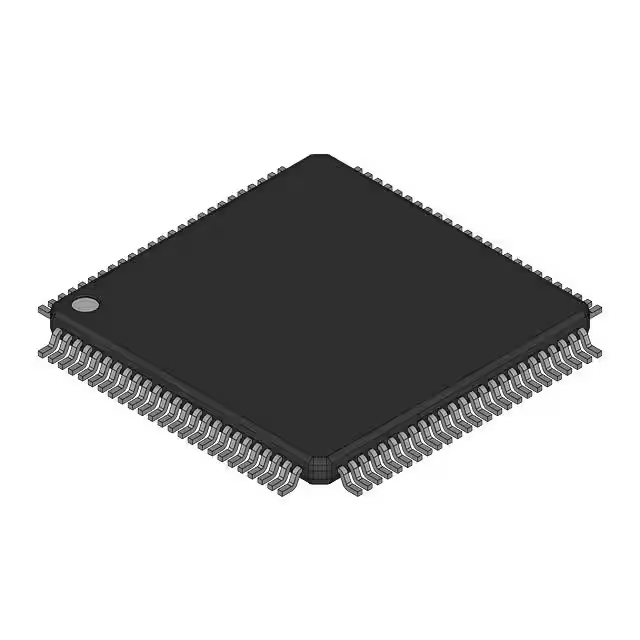
EPM1270GT144C3N

Active - IC CPLD 980MC 6.2NS 144TQFP
Description:
IC CPLD 980MC 6.2NS 144TQFP
EPM1270GT144C3N Specification
Product Attribute
Attribute Value
Programmable
Not Verified
Programmable Type
In System Programmable
Delay Time tpd(1) Max
6.2 ns
Voltage Supply - Internal
1.71V ~ 1.89V
Number of Logic Elements/Blocks
1270
Operating Temperature
0 ℃ ~ 85 ℃ (TJ)
Mounting Type
Surface Mount
Supplier Device Package
144-TQFP (20x20)
EPM1270GT144C3N Description
## Overview
The Altera EPM1270GT144C3N is a member of the MAX 7000S family of high-performance, non-volatile CPLDs designed for embedded control, interface logic, and glue logic applications. It offers moderate logic density, deterministic timing, and low power consumption suitable for commercial, industrial, and consumer electronics systems. Its EEPROM-based architecture enables instant-on operation without requiring external configuration memory.
## Architecture
* Technology: Electrically Erasable Programmable Logic (EEPROM-based CPLD)
* Logic Array Blocks (LABs): 14
* Macrocells: 270
* Input/Output Blocks (IOBs): 144
* Package: 144-pin Thin Quad Flat Package (TQFP)
* Speed Grade: -3
* Operating Temperature Range: 0°C to +70°C (commercial)
* Non-volatile configuration provides instant-on operation and eliminates dependency on external PROMs
* Each macrocell supports combinational or registered logic with multiple product term expansion
* Hierarchical interconnect ensures predictable timing and low-latency communication between LABs and IOBs
This architecture is well-suited for designs requiring moderate logic resources, multiple I/O interfaces, and deterministic signal propagation across complex systems.
## Logic Resources
* Total Macrocells: 270
* Flip-Flops: Embedded in macrocells for sequential logic
* Look-Up Tables (LUTs): 4-input combinational logic per macrocell
* Product Terms per Macrocell: Up to 8
* Output Configurations: Combinational, registered, or registered with product term expansion
* Supports implementation of finite-state machines, address decoding, arithmetic operations, and interface bridging
* Deterministic propagation delays allow multi-clock domain designs with predictable timing
## I/O Features
* Number of I/O Pins: 144
* I/O Standards: TTL compatible, 5 V signaling
* Input Voltage Thresholds: V_IH ≥ 2 V, V_IL ≤ 0.8 V
* Output Drive: Standard TTL capable of driving multiple standard loads
* Pin-to-Pin Propagation Delay: Typically 8–10 ns
* Flexible I/O structure supports interfacing with microcontrollers, memory devices, peripheral devices, and sensors
* IOBs can be configured for combinational, registered, or open-drain output configurations
## Timing Characteristics
* Maximum Operating Frequency: Approximately 50–60 MHz for typical combinational paths
* Pin-to-Pin Propagation Delay: 8–10 ns typical
* Macrocell-to-Macrocell Delay: 3–5 ns typical
* Supports multi-clock domain operation with minimal skew between critical signals
* Deterministic timing makes the device suitable for interface bridging, glue logic, and control applications requiring reliable propagation delays
## Power Characteristics
* Core Voltage: 5 V typical
* I/O Voltage: 5 V standard
* Typical Power Consumption: 100–200 mW under moderate activity
* Maximum Power Consumption: Approximately 400 mW under full utilization
* Low static and dynamic power suitable for embedded and industrial applications
* Non-volatile configuration minimizes standby power and supports instant-on operation
## Package and Integration
* Package: 144-pin TQFP
* Pin Pitch: 0.8 mm typical
* Compact form factor suitable for surface-mount PCB assembly
* High I/O density enables integration of multiple peripheral interfaces and flexible system design
* Provides reliable integration of moderate logic and I/O functions in space-constrained applications
## Applications
* Embedded control and finite-state machines
* Glue logic and interface bridging between microcontrollers, memory, and peripherals
* Address decoding and digital signal routing
* Industrial control and automation systems
* Consumer electronics requiring low power and instant-on capability
## Development and Tool Support
* Supported by Altera MAX+PLUS II and Quartus II design software for design entry, synthesis, fitting, timing analysis, and device programming
* JTAG interface available for in-system programming and functional verification
* Predefined logic functions and IP cores facilitate rapid implementation of standard interfaces and glue logic
* Simulation and timing analysis tools enable verification of multi-clock designs and critical paths
* Non-volatile EEPROM configuration ensures robust, predictable operation and instant-on functionality
The Altera EPM1270GT144C3N is a mid-density CPLD offering non-volatile configuration, flexible I/O, deterministic timing, and low power consumption. It is optimized for embedded control, interface bridging, glue logic, and moderate-complexity digital applications in industrial, consumer, and embedded systems.
EPM1270GT144C3N Stock: 43910
5.0 / 5.0

2021-08-12 12:06
IGBT transistors not detected SA for testerach beside plus t7-h, in tescie for przelaczanie with-12V for E plus zarowka powered + 12V for C triggered finger with Plus, zalancza with-wylancza. Very fast wysylka, fast delivery, product good jakosci, very we
2021-12-31 23:06
Good product and work correctly .
2021-07-09 02:45
Well received, not tested yet
2021-12-03 00:22
I order 10pcs. Now test three chips and two was ID 0x441, wich is STM32F412, not STM32F407. I am wery disapointed.
2021-12-27 06:22
The goods are very satisfied, the seller Thank you very much.


 Poland